Tuesday, 6 March 2018

Quibans 83: four diagrams

Here are four diagrams I have seen recently.  These form a brief Quibans.

The task: critique/explain/criticise these diagrams.

This was shared on Twitter:

These come from the Daily Telegraph:


Comments/possible answers:

1)  (Image from Twitter - can't recall exactly where.)
There appear to be 180 days in a school year.  The times all work: eg 180 days x 20 mins per day = 3600 mins per year ( = 60 hours).

The number of words read is rather strange though.  The obvious thing would be to assume a constant reading speed and therefore to divide the number of words per year by the number of minutes.  This gives 500 wpm for the first group, 313 wpm for the second group and 44 wpm for the third group.  Maybe you get quicker at reading the more you do, but even so there is a massive disparity here.

The number of books shown is not reasonable either.  The shortest Harry Potter novel (the first one) has about 77,000 words.   The first group would read 23 of these per year, the middle group about 3 and a half and the final group about a tenth of the book.

2)  It seems very strange to have a graph with two lines on it where one is essentially the inverse of the other!  The only people who aren't included on the graph are those who refused to state whether they were for or against Trump.  Other than that, if the number of people who approve goes down then you might be unsurprised if the number who disapprove goes up!

Here I have reflected the red line and placed it on top of the blue line.  A pretty good match!


3)  Here people were asked to recall the food they had eaten that day and the calories were calculated.  Then the actual food they had eaten was used and it was found that many people underestimated massively (forgetting about snacks etc)).
On average, men thought they had eaten 2065 calories (less than the 2500 recommended amount) but had actually eaten 3119 calories.  For women the figures were 1570 and 2393.
The percentage increase is 51% for me (so they ate just over 50% more than they thought) and 52% for women.  It is perhaps surprising that this is essentially the same for both genders.

4)  BMI (Body Mass Index) is calculated by dividing your weight in kg by the square of your height in metres.
There are certain parts of the country that have more overweight people.  What constitutes a 'region'?
It appears, for example, that Cambridge is a yellow section surrounded by a sea of orange.  If Cambridge were considered part of the rest of Cambridgeshire then presumably it would all be orange there.  The way different streets/villages/towns, etc are aggregated makes a big difference!


Sources:
https://pbs.twimg.com/media/DXXcqHkX0AA3M98.jpg
https://www.telegraph.co.uk/business/2018/03/02/world-reacts-horror-trump-delights-hobbesian-trade-wars/
https://www.telegraph.co.uk/science/2018/03/06/britains-new-diet-400-600-600-plan-counter-obesity/

Thursday, 1 March 2018

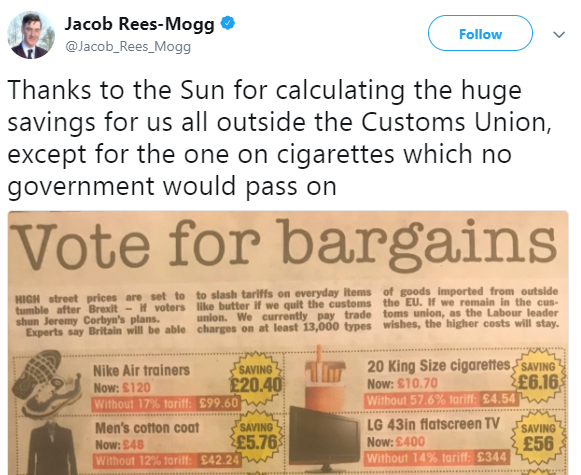
Quibans 82: The Sun and Rees-Mogg

Jacob Rees-Mogg tweeted a photo of an article from The Sun.
Here's screenshot of his tweet:

Rees-Mogg wrote "thanks to the Sun for calculating the huge savings".  Unfortunately they got them wrong.  All of them.

Q1) Explain what they have done wrong.  
Q2) Work out the correct values.

Here is the picture Rees-Mogg posted:


Thursday, 15 February 2018

Quibans 81: Good graph, bad graph

Here are two data representations from the same Daily Telegraph article about shootings in schools in the USA.

Comments?


My thoughts are below.

.

.

.

.

.

.

.

I like the first one.  This is very clear and shows when incidents occurred.  There seem to be several weeks where lots of incidents happened.
February was less incident-filled than January.  (NB this graph was published 15 Feb.)
There are some confusing things: Was 15 Jan a school-day?  There was an incident on a Saturday. What does 'incident' mean?  On the black-cross days - were there 2 incidents or more than that.

In the second graph things seem completely backwards!  Here a smaller bar means the mass-shootings were closer together, which doesn't seem obvious.  Is there a better way to show this? 
Does it matter that the groups of years are not the same size? 

Lots to talk about here!

Source: http://www.telegraph.co.uk/news/2018/02/15/americas-gun-crisis-will-never-end-liberals-learn-make-peace/ 

Monday, 5 February 2018

Quibans 80: Manchester Disunited


Man Utd face pressure to end 'grotesque' failure to pay Living Wage while Alexis Sanchez earns £600k-a-week


1 FEBRUARY 2018

Manchester United will come under major pressure on Thursday to end their “grotesque” failure to pay all workers there the “real” Living Wage after making Alexis Sanchez the highest-paid player in Premier League history during the transfer window.

In November both United and Manchester City faced political pressure to join Liverpool in pledging to ensure everyone who carried out work on their behalf would receive at least £8.75 per hour.

Led by civil society alliance Manchester Citizens, part of campaigning charity Citizens UK, Thursday’s action is accompanied by a release headlined ‘Manchester Divided’, which proclaims Sanchez’s signing has further exposed “a grotesque tale of halves”, in which five of the highest-paid players in the Premier League play for United or City - including Paul Pogba, Kevin De Bruyne, Romelu Lukaku and Zlatan Ibrahimovic - while “low-paid staff at the Theatre of Dreams are facing a real nightmare to meet the real cost of living”.

It also claims Sanchez makes almost as much during one half of football than the annual salary of some cleaning, catering and security staff who work at Old Trafford (£14,625), that it would take someone on the minimum wage 41 years to earn the £600,000 the Chilean takes home each week, and that his agent’s reported £15 million fee would be enough to fund Living Wage pay rises of almost £2,500 for 6,100 low-paid workers.

One such worker at Old Trafford, who did not want to be named for fear of reprisals, said: “We all share the same employer and it would be great if the club could think about all workers’ wages, from football stars to stadium cleaners and caterers”.


Questions:

1) How much does Sanchez earn per year?

2) Assuming he pays tax at 45% on his earnings, how much is his weekly take-home pay?

3) If the stadium workers earn £8.50 per hour, how many hours per week do they work?

4) Example the claims in the penultimate paragraph. Are they true?

5) If he drops a 50p coin, is it worth his while to bend down and pick it up?


Answers:

1) £600,000 x 52 = £31.2 million

2) £330,000 (while he will have a tax-free allowance of about £10,000 and a lower rate for the next chunk of his salary, this is negligible).

3) This is about 36 hours per week, assuming they work for 48 weeks per year. There is something a little strange here, in that presumably many more staff are needed during a match than on other days. Presumably many of the workers are therefore part-time.

4) In one half of football Sanchez makes £14,625? This works if he is considered to be ‘working’ for 30 hours per week throughout the year.

41 year? Yes.

Agent’s fee of £15 million? Yes

5) If you divide his salary up across the week it comes to about 99p per second (even for the time he is asleep). In the ~2 seconds it would take for him to lean down to pick up a 50p coin he will have earned 4 times that!


Source: http://www.telegraph.co.uk/football/2018/02/01/man-utd-face-pressure-end-grotesque-failure-pay-living-wage/

Saturday, 27 January 2018

Quibans 79: Nutella Riots

From the BBC:

Nutella 'riots' spread across French supermarkets


A discount on Nutella has led to violent scenes in a chain of French supermarkets, as shoppers jostled to grab a bargain on the sweet spread.
Intermarché supermarkets offered a 70% discount on Nutella, bringing the price down from €### (£3.90) to €1.40.
But police were called when people began fighting and pushing one another.
Some 365 million kilos of Nutella, a hazelnut chocolate spread, is consumed every year in 160 countries around the world.

Here is information about Nutella from the Tesco website:
  • Pack size: 750g

Ingredients

Sugar, Palm Oil, Hazelnuts (13%), Fat-Reduced Cocoa (7.4%), Skimmed Milk Powder (6.6%), Whey Powder (Milk), Emulsifier: Lecithin (Soya), Vanillin

50 Portions per jar = 50 x 15g


What can we work out?  Some ideas are below.

.

.

.

.


Q1)  Work out the missing number
Q2)  What is the exchange rate?
Q3)  How many portions are sold each year?
Q4)  How many tonnes of Nutella are sold each year?
Q5)  How many kg of hazelnuts/coca/milk are used each year?
Q6)  Ingredients are listed in order (highest amount to lowest).  What is the smallest percentage of sugar there could be?


Answers
Q1)  Intermarché supermarkets offered a 70% discount on Nutella, bringing the price down from €4.50 (£3.90) to €1.40.
This is interesting because if you do 1.40/0.3 you get 4.67
There has been some rounding going on!  The actual discount is 68.9%
Q2)  £1 = €1.15
Q3)  365 million kg divided by 15g = 24 billion servings.  (That's more than 3 servings per person on the planet)
Q4)  365,000 tonnes  - that's 1000 tonnes per day!
Q5)  Hazelnuts - 47,000 tonnes, Coca - 27,000 tonnes, Milk powder - 24,000 tonnes
Q6)  If the smallest three ingredients are the biggest they can possibly be then they will each be 6.6% and the total of everything other than sugar and palm oil is 46.8%.  The smallest the sugar can be is half of what remains, which is 26.6%.  In reality this is likely to be a big underestimate.


Sources: www.bbc.co.uk/news/world-europe-42826028

https://www.tesco.com/groceries/en-GB/products/250838346

Tuesday, 16 January 2018

Quibans 78: Expensive wine

In my Spanish class we read a newspaper article about the most expensive wine in the world.  Here is my translation of part of that article:

This is the most expensive wine in the world and it’s made in Spain.
Each bottle of AurumRed ‘gold series’ costs €25,000.  Hilario García produces 300 of these bottles per season, of which he sells 150 immediately and reserves the rest for repeat clients, and there are some of them.
The cellar also produces 6,000 bottles per year of the ‘silver series’, at €2,200 per piece and 3,000 bottles of sauvignon blanc, which is much more accessible at €30.

Questions:
1)      What is the average cost of a bottle of wine from this vineyard?
2)      Comment on the usefulness of this answer


Translation: MD

Original text:
Así es el vino más caro del mundo, que se hace en España
Cada botella de AurumRed serie oro cuesta 25.000 euros.  Hilario García produce al año 300 de estas botellas, de las que comercializa 150 por temporada, y reserva el resto para los clientes que quieren repetir, que los hay.

De la bodega salen también 6.000 botellas al año de la serie plata, a 2.200 euros la pieza, y 3.000 de sauvignon blanc mucho más asequibles, a unos 30 euros.

Wednesday, 10 January 2018

Quibans 77: Brussels Sprouts at Lidl

On the radio this morning they reported:
Lidl supermarket said it had record UK sales in December, with a rise of 16% on the same period in 2016.
Customers bought about #### tonnes of Brussels sprouts.


I told my class this and said that the first digit of the number of tonnes of sprouts was a 6.  They then worked out a likely number.

What they did is below.
.
.
.
.
.
.
.
.
.
.
.
.
Here is one solution.  Others were shared too.
  • Assumption: 1 sprout weighs about 10g.  We know that 1 tonne = 1 million g, so this is 1/100,000 of a tonne.
  • Assumption: Each person in the country has 5 sprouts at Christmas.
  • Assumption: There are 64 million people in the country.

Multiplying these gives a total sale of 3200 tonnes of sprouts.
Some people buy these from supermarkets (and there are lots of these: Tesco, Sainsburys, Morrisons, Asda, Waitrose, Lidl, Aldi, M&S, Co-Op, Spar), some from local shops and others will grow their own.
Those studying business studies predicted that Lidl might have approx 10% market-share.  
We assumed that this meant they sold 10% of the sprouts too (this is an assumption we need to make.  For example, Iceland (the shop) has more frozen food, so their market share couldn't be used to predict sales for fresh produce).
Lidl would therefore sell 320 tonnes of sprouts.

The next part is the thing I found particularly interesting.  The students pointed out that 320 tonnes was almost exactly midway between 60 tonnes and 600 tonnes.  The halfway point is 330 tonnes.  The students were aware that in an answer as full of estimates as this they couldn't say that their 320 is less than 330 (which is right and sensible), but they were unclear whether they should round up to 600 or round down to 60.

After discussion they were happy with the idea that we usually think in a multiplicative way about our errors in a question like this (so we predicted 5 sprouts per person, but it could have easily been double that).  To get to 600 you multiply by a number less than 2, whereas if you divide by 5 you haven't reached 60.  They decided on 600 tonnes as the answer.

Here is the start of the story (from the BBC News site):
Lidl supermarket said it had record UK sales in December, with a rise of 16% on the same period in 2016.
Customers bought about 600 tonnes of Brussels sprouts

Quibans 111: How much energy and water do our AI tools really use?

Here is how I used the article below from the Times.  Before showing the article, I started with this information and these questions: Mic...