Thursday, 10 November 2016

Quibans 48: Trump and the pollsters

From The Guardian:

This was a good starting point for a Quibans.

First of all, if there was a “15% chance” and that happened, it doesn’t necessarily mean the prediction was wrong – just that something less likely did occur.

I didn’t understand that comparison that was given here.

Questions:
  1. What does this mean:  15% chance is roughly the same as rolling a six if you have two dice.
  2. Can you come up with a better comparison that uses coins, dice, cards, etc.

Answers:
  1. It might mean

  • Getting a sum of 6 when you roll two dice.
  • Getting exactly one six if you roll two dice.
  • Getting one or more sixes if you roll two dice
A probability table might be useful here:


This shows the total of the two dice.  There is therefore a probability of 5/36 of getting a total of 6, which is about 13.9%

This table shows (in yellow) the ones where exactly one die shows 6.  10/36 = 27.8%
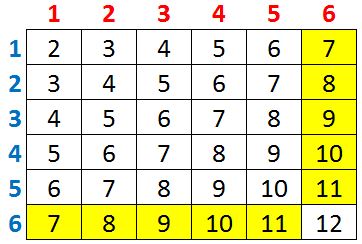


If we include a double-six too then that rises to 30.6%

The first of these (a total of 6) is nearest to 15%.  If it had said “getting 8 when you roll two dice” the probability would have been the same but the ambiguity would have been removed.

A better comparison
The probability of getting a 6 on a six-sided die is 1/6, which is 16.7%.  This is so much clear but is only a tiny bit less accurate than the suggestion in the article, so this is arguably better.
The probability of getting an Ace or a King from a pack of cards is 8/52 = 15.4%, which is very close and is also easy to understand.


[Other issues related to this also appear on my blog.  Find it here.]

Source:


Friday, 4 November 2016

Quibans 47: Shortest flights

From the Daily Telegraph:

The world's 10 shortest flights

A list of the world's 10 shortest regular commercial flights contains an international service for the first time, thanks to a 13-mile, eight-minute route between Switzerland and Germany that launched today.
In more excitement for fans of ludicrously brief forays into the sky, this week the world’s largest commercial aircraft - the Airbus A380 - was handed a regular outing on its shortest ever flight - a mere 235-mile jaunt between Doha and Dubai. Emirates, the airline behind the route, regularly uses the behemoth "superjumbos" on 8,000-mile odysseys, but instead thought it could be put to good use nipping between the two Middle Eastern cities. The journey could conceivably be made 40 times before the need to refuel.
But what of the rest of the world’s tiniest hops?
The competition to become a member of this club is not as fierce as it is at the other end of the scale, where airlines battle to out-fly each other to the longest non-stop schlep, but is nevertheless one of intrigue.
Topping the table is the wonderfully unconventional two-minute Loganair service between Westray and Papa Westray in Scotland’s Orkney Islands, which are separated by just 1.7 miles of land and sea. It can be completed in as little as 47 seconds, depending on the direction of the wind, and welcomed its millionth passenger this week. 
Featuring more obscure airlines, such as Pacific Wings and Guam’s finest carrier, Freedom Air, read on to find out about 10 flights that cover a total of just 91.5 miles - less than the distance between London and Bristol.


What a great story!  What can we work out?

Questions:
  1. What is the average speed for each journey? (We could do this for the new route and also for the Orkney flight.)
  2. How far can the A380 fly without needing to refuel?
  3. What sort of correlation is there between the length of the flight in miles and the length in minutes?

Here is the data from the image, shown in a spreadsheet:

Distance
Duration
miles
mins
10
Cayman Brac
14 miles
10 mins
14
10
9
Friedrichshafen
13 miles
20 mins
13
20
8
Karpathos
12 miles
5 mins
12
5
7
Papeete
11 miles
15 mins
11
15
6
Saipan
10.8 miles
10 mins
10.8
10
5
Connemara
10.4 miles
6 mins
10.4
6
4
Hoolehua
8.8 miles
10 mins
8.8
10
3
Minami-Daito
7 miles
15 mins
7
15
2
Caye Chapel
2.4 miles
2 mins
2.4
2
1
Westray
1.7 miles
2 mins
1.7
2

Answers:
13 miles in 8 minutes means 1.625 miles in 1 minute and 97.5 mph.
1.7 miles in 47 seconds means 0.036170213 miles in 1 second and (multiply by 3600)
130mph.
235 x 40 = 9400 miles.  But this might not be accurate, because it will presumably depend on wind-direction and wind-speed, there will be 40 take-offs and 40 landings rather than just one of each, which might use a different amount of fuel.  Presumably there are also rules about having to have a certain amount of fuel in reserve in case of bad-weather diversions, etc.
The pmcc is 0.58, which shows a weak positive correlation.  We could also draw a scattergraph.


Sunday, 30 October 2016

Quibans 46: Commuting in London

From the London Evening Standard:

One in three Londoners lose one day every week from commuting
A third of Londoners spend the equivalent of a whole day’s work every week commuting to and from the office, a study revealed today.
The findings were revealed in the annual London Commuter Index which looks at attitudes towards daily commutes.
It found that 30 per cent of workers spent an average of eight hours and 45 minutes a week on their commute, and 31 per cent were commuting for an average of six hours and 15 minutes.
Cost of travel was also shown to put workers under financial strain, with more than half spending an average of £1,500 on annual season tickets — the equivalent of paying the average London rent for about two months.
Three quarters of Londoners said reducing this expense would improve their journeys.
To beat rush-hour blues more than 64 per cent of commuters said they listened to music — and more than one in 10 practised mindfulness during their journeys.
About 61 per cent of people thought overcrowding was the worst part of commuting, while 28 per cent said it was delays. A survey of Tube passengers found a third liked the Victoria line best, while 36 per cent said the Central line was worst and would be improved by air conditioning.
The survey was carried out by season ticket loan company CommuterClub which quizzed 554 customers.


Questions:

1)  How many people made each statement? 

2)  How long is each journey if the total in the week is 8 hours 45 mins?

3)  If everyone not mentioned has an average commute of 3 hours, what is the average commute for everyone in London?

4)  Which part of the article doesn’t seem sensible? 

5)  How might they have collected the data?
What can we do with the information about the cost of the tickets?

Answers:

1)  How many people made each statement? 
% given
lower bound
'exact'
upper bound
lowest integer
highest integer
30%
163.43
166.2
168.97
164
168
31%
168.97
171.74
174.51
169
174
75%
412.73
415.5
418.27
413
418
64%
351.79
354.56
357.33
352
357
10%
52.63
55.4
58.17
53
58
61%
335.17
337.94
340.71
336
340
28%
152.35
155.12
157.89
153
157
33.333%
181.8967
184.6667
187.4367
182
187
36%
196.67
199.44
202.21
197
202
[To work out the final two columns I used the Excel formula “Ceiling.Math” and “Floor.Math”]

2)  How long is each journey if the total in the week is 8 hours 45 mins:  This is 525 minutes.  Divide it by 10 (5 days of travelling there and back) to get 52 and a half mins per journey.

3)  Average:  5 hours 44 mins

4)  Which part of the article doesn’t seem sensible:   How will having a cheaper ticket make the journey more bearable?  Do people get grumpy at delays and overcrowding and then get even crosser because they are paying lots for the privilege?  Or would they be able to afford more takeaway coffee if the tickets were cheaper?

5)  How might they have collected the data:  Asking people at different stations.  Emailing those who use their website.  Are there any problems with this?


Quibans 45: Army fitness

From the Daily Telegraph:
Army fitness slips, but female soldiers close the gap on menThe proportion of Army soldiers failing fitness tests has nearly doubled in three years amid concerns that personnel are losing focus because they are not being sent to war.
Female troops are also narrowing the gap with their male counterparts after years of falling behind, The Telegraph can disclose.
In 2013, 7,120 - or 9.6 per cent - of the ### personnel who were made to complete personal fitness assessments failed at least one, according to figures released by the Ministry of Defence (MoD).
In comparison, between January and mid-September this year ### troops - around 17.7 per cent - out of a possible 63,910 tested failed one or more.
Three years ago, just over 12 per cent of females tested failed at least once, while 9.4 per cent of men did. This year, 18.8 per cent of women and 17.6 per cent of men failed one or more assessments.  
One recently retired Army officer suggested that soldiers were finding it more difficult to focus on keeping fit because they knew they were not going on operations.
He said: "Operations sharpen the mind and focus your efforts on keeping fit - the prospect of going to Afghanistan was certainly an incentive to get fit. After all you don't want to let your mates down by being unfit and not prepared. Being shot at is hard enough when you're fit, let alone when you're out of shape."

Questions:
1)  There are some blanked out numbers to calculate.
2)  In what way are the female soldiers “closing the gap”?
3)  From these figures there clearly aren’t the same number of men and women who were tested.  What is the ratio of men to women?

Comment:
If you have used any of the others that focus on rounded values, you could ask students at this stage what the upper and lower bound is for each blanked out number.

Answers:
1)  Here is the unedited excerpt:
In 2013, 7,120 - or 9.6 per cent - of the 74,010 personnel who were made to complete personal fitness assessments failed at least one, according to figures released by the Ministry of Defence (MoD).
In comparison, between January and mid-September this year 11,300 troops - around 17.7 per cent - out of a possible 63,910 tested failed one or more.
Here are the upper and lower bounds for each calculation (note that the numbers of troops might be rounded to the nearest 10 or might be exact – we can’t tell).
7120
9.6
74167
7120
9.55
74555
7120
9.65
73782
17.7
63910
11312
17.65
63910
11280
17.75
63910
11344

2)  The gap between the performance of the men and the performance of the women is smaller.  Given that both have got worse that doesn’t seem like a result to be excited about!

3)  This is interesting.  I haven’t thought about this sort of thing before.  In 2013, 9.4% of the men and 12% of the women are 9.6% of the total.

If the number of men is m and the number of women is w then we have

9.4m + 12w = 9.6(m+w)
2.4w = 0.2m
12w = m
So there are 12 times as many men as women.

In 2016, 17.6% of the men and 18.8% of the women are 17.7% of the total.
17.6m + 18.8w = 17.7(m+w)
1.1w = 0.1m
11w = m
There are 11 times as many women as men. 

This might mean that there are now more women in the army than there used to be, or that more women were tested second time around, or that the percentages given were not exact …


Quibans 44: Glastonbury

Glastonbury 2017 tickets sell out in less than an hour as music fans complain about festival website crashing
Bad news for anyone still hoping to make it to Glastonbury Festival 2017: over 100,000 tickets sold out this morning before 10am, amid complaints that the ticketing website was crashing
The coveted tickets were released this morning at 9am and were all gone before 10.  The festival organisers posted the tweet below, breaking the news to disappointed music fans, at 9.54am.

A smaller batch of  15,000 tickets with coach packages, released on Thursday last week, are also all gone, selling out within 23 minutes.

Questions:
  1. What is the rate at which the tickets sold?
  2. What is the rate at which the ‘tickets with coach packages’ sold?
  3. What is the combined rate for both types of ticket?
  4. How long did each standard ticket take to sell?
  5. How long did each ‘ticket with coach package’ take to sell?
  6. How long did each ticket take to sell on average?


Comments:
It is necessary to choose units here.  This could be ‘number of tickets per minute’ (or per second, or per hour).  The other big idea is that when combining both types of ticket we can’t just take the average.  We need to use the total number of tickets divided by the total time.


Quibans 110: American eating habits

From the Daily Telegraph My British mind boggles at American eating habits Outside a convenience store in Kansas, I got talking to a ma...