Sunday, 27 March 2016

Quibans 25: 3 short food & drink stories

Three shorter Quibans, all related to food and drink.

From the Guardian:
Caffeine hit: what happens to Britain's 3bn empty coffee cups?
Britain’s coffee shops hand out 3bn paper cups every year. Yet, supposedly, fewer than one in 400 is being recycled.
“I see this as a house of cards,” says Peter Goodwin, one of the founders of Simply Cups, a company dedicated to the recycling of paper cups. By the middle of last year, his business recycled around 1m cups, and he hopes to raise that number to 6m by the end of the year. Even if he does, it will be a mere bean of our coffee consumption. “While everyone may have been under the impression that these products were being recycled, the reality is they more than likely weren’t,” he says.
The problems all begin with the cup. It is made from paper laminated with plastic, to be watertight. But the compound creates a complicated recycling proposition. It cannot be viably treated as pure paper.
Questions:
  • How many cups per day? Per hour? (Bear in mind that coffee isn’t purchased as much in the middle of the night!).
  • The article says that fewer than one in 400 cups is recycled. How many is that?
  • What fraction of the cups are recycled by Simply Cups?
Source: http://www.theguardian.com/environment/2016/mar/15/coffee-cup-britons-3-billion-so-few-recylced


From the Daily Telegraph:
Budget 2016: Sugar tax on soft drinks
In a shock move, George Osborne announces new taxes on sugary drinks, with funds raised to go towards more sport in primary schools

The cash raised - an estimated £520 million a year - will be spent on doubling funding for sport in primary schools, the Chancellor said.
He suggested the changes were a chance to save a generation,
“We cannot have a long-term plan for the country unless we have a long-term plan for our children’s healthcare,” Mr Osborne told the Commons.
“Five-year-old children are consuming their body weight in sugar every year.

The two tiers of taxes mean that a few soft drinks such as Tango and Lilt will be exempt, because their sugar content is below 5g per 100ml.
A number of drinks, including Fanta and Sprite, with between 5g and 8g added sugar per 100ml, which will be taxed at 18 pence per litre.
But the highest tax of 24 pence per litre will fall on dozens of the most popular drinks, including Pepsi, Coca-Cola and Ribena.
Sugar content:


What questions can you ask/answer?  Here are some ideas:
  • How much tax will you pay on a can of drink?
  • If £520 million will be raised, how much is drunk per year?
    • (£520m divided by about 60m people gives about £9 in tax per person per year. If we assume that most drinks are taxed at 8p per can then £9 divided by 8p gives about 110 cans on average per person per year. That’s about one every three days.)
  • What percentage of its sugar does Irn Bru need to lose to get under 5g per 100ml?
  • What percentage of its sugar does 7Up need to lose to turn it into Sprite?
  • Taking Sprite as our starting point, how does Tango Orange compare? What about Coca-Cola? What about ginger beer?
Sources:
http://www.telegraph.co.uk/news/health/news/12195786/Budget-2016-Sugar-tax-on-soft-drinks.html
http://www.telegraph.co.uk/food-and-drink/news/sugar-tax-what-does-it-mean-and-who-will-be-affected/


From The Independent:
What would happen if everyone in the world became a vegetarian?
It is estimated that for every cow that is made into beef (remember there are about 1.5bn of them out there), it takes 15,000 litres of water to help them grow and for the land they graze.
Obvious questions:
  • How much water is that altogether?
  • What does 15,000 litres of water look like?
  • What does the total amount of water look like? Is that a lake-full, a sea-full, a drop in the ocean?
Source: http://indy100.independent.co.uk/article/what-would-happen-if-everyone-in-the-world-became-a-vegetarian--b1ggUk2tWgW

Friday, 25 March 2016

Quibans 24 - Tunnels

From the Cambridge News:
University of Cambridge study to tackle Cambridge transport – including tunnels and driverless cars

Some of the world's best transport engineers are turning their eyes to solving Cambridge congestion. Things like tunnels and innovative new vehicles are all on the table for the study commissioned by the University of Cambridge.
Professor Lord Mair is the university's head of civil and environmental engineering and one of the world's foremost experts on tunnels, having been involved with projects such as HS2 and Crossrail.
He told the News: "This is going to be a feasibility study which I think will really change the way Cambridge thinks about congestion and how people move around the city.
"Our remit is to look at options. It might be more or less direct, it could involve some underground, it could involve some overground. It could go within the city centre, and that would probably be underground.
"The important thing is, the ground conditions are very favourable for creating economic tunnels, particularly if they're relatively small in diameter." Lord Mair added that smaller tunnels of say 4 metres in width would cost about a quarter of those 8 metres in width, with the costs reducing as a greater proportion the narrower the tunnels got.

  • The obvious question is why a tunnel of half the width would cost about a quarter as much.
  • We could work out the cross-sectional area of a circular tunnel of width 8m and one of width 4m, and could also do the same for a square tunnel of widths 8m and then of 4m.  
  • Having established that the area is a quarter, why would this affect the cost?  (A quarter as much soil to dispose of, etc.)
  • Why might it not be a quarter of the cost?  
    • There are fixed costs that would be the same regardless of the width of the tunnel (eg survey costs, buying land, diverting streams, legal costs, etc).
    • The inside of the tunnel needs to be lined with concrete blocks.  How is this affected by halving the width?  Work out the perimeter of the circular tunnels (8m and 4m) and of the square tunnels.  
    • The calculation before is only approximate.  Look at the diagrams below and work out the area of the concrete if it is 30cm thick.
    • The smaller digging machine might not be a quarter of the cost.
    • You might not need a quarter of the people to run the machine.
    • The bigger machine might work more slowly so it takes longer.
    • Any others?  
  • Is a 4-metre tunnel big enough for 2-way traffic?  High enough for buses?  How small could the tunnels get?

Sunday, 6 March 2016

Quibans 23: Custard Creams

A short Quibans from the BBC website:
How have we coped without biscuits?
Britain has been experiencing a severe shortage of biscuits - an unforeseen and yet, for some, very serious impact of the recent Cumbria floods. How have we coped?
Storms Desmond and Eva left swathes of Cumbria, Lancashire and Yorkshire under water, causing widespread personal pain and huge economic cost.
They also submerged Carlisle's McVitie's factory ovens, halting production of custard creams, bourbons, ginger nuts and table water biscuits.
Used to consuming about 34,000 tonnes of biscuits a month, the British public were suddenly facing gaps on shop shelves.

However, there is now some hope for the British public - production of ginger nuts has restarted and should be back on the shelves by mid March.

There are some reasonably obvious questions:

  • How many packets of biscuits are consumed per person in Britain each month?
  • What about each year?
  • What weight of biscuits are consumed in total per year in Britain?
  • How much would they cost?


Source:
http://www.bbc.co.uk/news/uk-england-cumbria-35696027

Friday, 4 March 2016

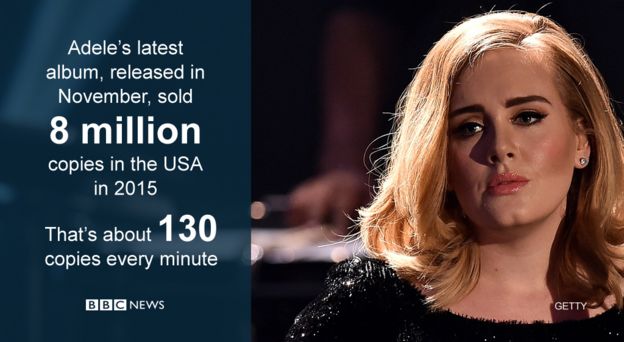
Quibans 22: Adele

From the BBC website:


What questions can you ask and answer?

This is brilliant because you can work out very easy things like:

  • How many copies were sold per second, per hour, per day, etc
My favourite question is:
  • When was the album released? (Which date?)
You can also do some 'unrounding' and decide that the "8 million" is not absolutely exact, so what will the upper and lower bounds for the release date be.

You can then do some estimating and decide roughly how much money Adele will have made during that month-and-a-bit.  


Source:
http://www.bbc.co.uk/news/blogs-magazine-monitor-35672287

Sunday, 21 February 2016

Quibans 21: Shoppers fail to spot cheapest deals

So many people have sent me a link to this news story!  One way to use it would be to give students the link to the story and to ask them to read it.  They could create questions on the way through and then answer the questions in the quiz.  http://www.bbc.co.uk/news/business-35539416

Unfortunately the answers are given at the end of the article, so you might want to use this cut-down version:


Shoppers 'fail to spot cheapest deals'

Most grocery shoppers are unable to identify the cheapest deals when faced with a blizzard of "special offers" in stores, financial experts say.

The Money Advice Service asked just over 2,000 consumers to select the best value deals from four sets of offers. Only 2% of those asked answered all four questions correctly.

In the survey, 76% of those asked said they spent more than they intended, after being enticed by special offers, paying an average £11 extra per shop.

Later on Thursday, Sainsbury's announced that it would phase out multi-buy promotions by August 2016. Sainsbury's Marketing Director, Sarah Warby said customers had told them they found multi-buy promotions "confusing" and created "logistical challenges at home in terms of storage and waste." The government-backed Money Advice Service said shoppers should look at the price per unit to compare costs. It also suggested making, and sticking to a shopping list.

Special offers test
The Money Advice Service tested shoppers with the following questions (answers at the bottom)

1. Of the following options for milk, which represents the best deal?
a) Six pints of milk for £1.80
b) Four pints of milk for £1.40
c) Two six-pint cartons of milk on offer for £3.50
d) Two four-pint cartons of milk on offer for £2

2. Of the following options for buying 500g of lemons, which represents the best deal?
a) One 500g pack of lemons costing £1.20
b) 500g of loose lemons at £2.50 per kilo
c) Buy two get the third free deal on 200g packs of lemons costing 70p each
d) Buy one get one half-price deal on 250g packs of lemons costing 70p each

3. Of the following options for buying tomato ketchup, which represents the best deal?
a) One 460g bottle on offer at £1.50
b) One 910g bottle costing £2.49
c) Buy one get one half-price deal on 700g bottles costing £2.29 each
d) One 1.35kg bottle costing £3.50

4. Of the following options for buying eggs, which represents the best deal?
a) Six medium eggs for £1.10
b) Ten medium eggs on offer for £1.50
c) Fifteen medium eggs for £2.10
d) Two packs of six medium eggs on offer for £2
e) Buy one get one free offer on packs of 10 medium eggs priced at £2.20


Other possible questions:
  • Roughly how many people got all four questions right?
  • 76% spent £11 more (on average).  How much (on average) was spent by each person?
  • Why might you sometimes not want to buy the best value option?

Answers to the quiz:
1d (25p per pint); 2d (£2.10 per kilo); 3c (£2.45 per kilo); 4e (11p per egg)

Source:

Quibans 20: Three short Quibans (from 'Go Figure')

The BBC has a feature on its website called Go Figure: The week in numbers.

Each day they tweet an image related to a number-filled news story and they gather these together at the end of the week.  Here are three short Quibans (with slightly longer versions that involve starting with the same image but then with extra information).  The short ones could be starter activities.

Quibans 20.1:  What questions can you ask/answer?
Shorter version:

Possible questions:

  • How much sugar should an adult have per year?
  • How many large chai lattes could an adult drink per year?
  • Three days would clearly be 90g of sugar, so how long (in days/hours/etc) should this drink be made to last?
Longer version:
'Shocking' sugar levels in High Street hot drinks, warns charity
"I used to drink a large white cafe mocha with caramel and vanilla syrup, cream on top, caramel and chocolate drizzle at Starbucks - approximately three times a day, seven days a week.
"I did this for about a year. At the time, I knew this drink had lots of sugar and fat, but I wasn't aware of just how much.
"At one point the assistant manager refused to serve me because they were concerned of the health impact. The rest of the staff continued to serve me.
"I drastically cut back on these sugary drinks after I was diagnosed with a very high cholesterol level and liver problems three years ago.
"I still have high cholesterol now and was recently diagnosed with a fatty liver - which means it is not working properly - not from alcohol but from sugar."
Question:
How much did the person quoted in the article exceed his annual sugar intake by?


Quibans 20.2:  What questions can you ask/answer?
Shorter version:

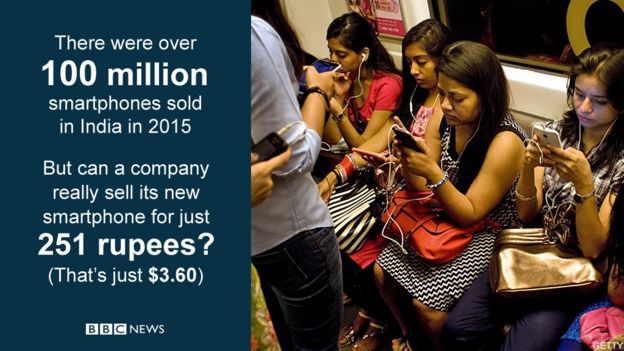
How much?! Some think the new smartphone will sell at a 90% loss

Possible questions:

  • What is the exchange rate between RS and $ ?
  • What is the cost of making them if they are sold at a 90% loss?
Longer version:
Is India’s $3.60 smartphone too good to be true?
On Wednesday evening a virtually unknown Indian company launched the "world's cheapest smartphone", named Freedom 251, for 251 rupees ($3.60; £2.50), in Delhi.

According to media reports, the Indian Cellular Association has written to telecoms minister Ravi Shankar Prasad saying it was not possible to sell a 3G phone below 2,700 rupees.

Smartphones, on the other hand, saw a huge spread in prices. But the top selling category, accounting for over 22% of smartphones sold in India in 2015, were for 4,000 to 6,000 rupees - rather than in the cheapest price range for smartphones, which starts below 3,000 rupees. So cheapest isn't the bestseller for smartphones.
Possible questions:
  • How much (in £) should the cheapest 3G phone cost?
  • How many smartphones cost between 4,000 and 6,000 Rupees?
  • What is the approximate total cost of those phones (in £)?


Quibans 20.3:  What questions can you ask/answer?
Shorter version:
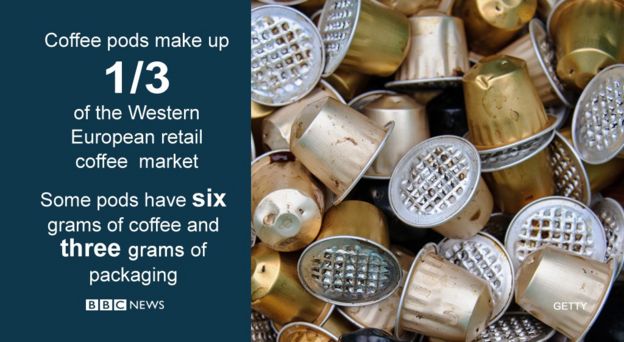
Coffee pods make up one third of the €18bn (£13.9bn) Western European coffee market.

Possible questions:

  • Find out how much a pod costs (Google, or online shopping site).  Then work out how many are sold each year.
  • How much packaging is produced?

Longer version:
Is there a serious problem with coffee capsules?

Coffee pods make up one third of the €18bn (£13.9bn) Western European coffee market.

In the last year more than £112m-worth of coffee pods were sold in the UK, up by a third from 2014. Sales are expected to treble by 2020, at which point coffee capsule sales could overtake those of tea bags.

In Halifax, 200,000 or more capsules have been kept away from landfill by convincing residents to take their coffee in a different manner.

Nespresso runs its own recycling programme, where it picks up used capsules for reuse. A company spokesperson said that it has in place the capacity to recycle over 80% of used capsules

Two billion cups of coffee are drunk around the world every day and 25 million families rely on growing coffee for a living. Over the past 15 years, consumption of the drink has risen by 43% - but researchers are warning that the world's most popular coffee, Arabica, is under threat.
Questions:

  • What fraction of the coffee pods sold in Western Europe were bought in the UK?
  • What was the cost of the UK pods in 2014?
  • 200,000 is what fraction of the UK pods sold in 2015?
  • How many pods can Nespresso?  [NB: they "have the capacity" to recycle this many - it doesn't mean that people do recycle them!]
  • How many cups of coffee does each producer create (on average) per day?
  • Global consumption of coffee has grown over the past 15 years.  But so has the global population.  Google the population 15 years ago and now and find out whether coffee consumption per person has actually gone up or down, and by how much.


Sources:
http://www.bbc.co.uk/news/blogs-magazine-monitor-35616091
http://www.bbc.co.uk/news/health-35593007
http://www.bbc.co.uk/news/world-asia-india-35601544
http://www.bbc.co.uk/news/magazine-35605927

Saturday, 6 February 2016

Quibans 19: Stolen Road

Bizarre, brief Quibans from BBC News:

Russia highway robbery: Official 'stole 50km road'

A senior prison official has been detained in Russia accused of stealing a 50km (31-mile) length of highway.

Police said Alexander Protopopov, acting deputy chief of Russia's prison service, oversaw the dismantling of the road in the far-northern Komi region. He then sold off its 7,000 reinforced concrete slabs for personal profit, they added. Officials believe the scheme cost the government more than 6m roubles ($79,000; £54,000).

The road was "dismantled and driven away" over the period of more than a year, between 2014 and 2015, the Investigative Committee said in a statement quoted by the AFP news agency.

The concrete slabs were then used by a commercial company which also sold them on for a profit, it added.

The construction of a mountain highway for the Sochi Winter Olympic Games cost about $8bn (£5.6bn), with Russian media claiming it would cost the same to slather the 48km road with black caviar.
So many questions!

  1. How big are the concrete slabs?
  2. How much does each slab cost?
  3. What is the exchange rate between Roubles, Dollars and Pounds?
  4. How much did the Sochi road cost per km?
  5. How thick would the caviar be?

Source:

Quibans 111: How much energy and water do our AI tools really use?

Here is how I used the article below from the Times.  Before showing the article, I started with this information and these questions: Mic...