Saturday, 30 January 2016

Quibans 17: Lee Child

From The Spectator:
Writing a bestseller ‘on the verge of a stroke’

Every four seconds, somewhere in the world, a Lee Child book is sold. This phenomenal statistic places Child alongside Stephen King, James Patterson and J.K. Rowling as one of the world’s bestselling novelists. But what makes the Jack Reacher books so successful? This is one of the questions Andy Martin, a lecturer in French and Philosophy at Cambridge, sets out to answer in this intriguing and uniquely unclassifiable book. Reacher Said Nothing, however, isn’t a work of literary criticism or a how-to guide. Martin contacted Child and asked whether he could observe the entire writing process for the 20th Reacher novel, Make Me. Amazingly, Child said yes.
‘So far I have no title, no real plot…. I don’t have a clue about what is going to happen,’ Child tells Martin on the first day. This, for most novelists, would be a startling admission, especially in crime fiction where plotting is paramount. Martin perches on a couch as Child sits down, lights a cigarette, and begins to write. By the end of the day, Child has smoked 26 Camels, drunk 19 cups of coffee (‘I’m writing on the verge of a stroke,’ he quips) and written 2,000 words.

Throughout the seven months it takes to write the novel, Martin continually questions Child over the choices he makes,

Possible questions:
  1. "Every four seconds ...".  How many books are sold each year?
  2. How much money does Lee Child make?
  3. How long is one of his books?
  4. How many cigarettes and cups of coffee did he consume while writing the book?

Answers:
  1. There are 365 x 24 x 60 x 60 seconds in a year (31,636,000 seconds).  Divide this by 4 to get 7,884,000.  Nearly 8 million copies per year.
  2. This is difficult to answer, because hardback books are more expensive than paperbacks, we don't know how much of the money goes to the publisher, on advertising, on the cost of printing, etc, and how much goes to the author.  Presumably it costs different amounts in different countries too.  If the author gets 50p per copy then that would be £4 million per year.
  3. We don't know enough about the writing process.  If he writes 2000 words every day for seven months then that is about 420,000 words.  If he writes 5 days a week then it would be 5/7 of that (300,000).  If half of the time is spent redrafting and rewriting then it would be about half that.  I looked up the length of the Harry Potter books.  They range from just over 75,000 words to over a quarter of a million words.  
  4. If his consumption was constant and over seven months of 5-day writing weeks then he would consume nearly 4000 cigarettes and nearly 3000 cups of coffee.

Friday, 29 January 2016

Quibans 16: The London Underground

This is a longer and more involved Quibans, using information taken from an article in the Daily Telegraph.  The article was headed "150 fascinating Tube facts".  I have only reproduced a handful of them below.
London Underground: 150 fascinating Tube facts

1. There is only one Tube station which does not have any letters of the word 'mackerel' in it (*)

2. The average speed on the Underground is 20.5 miles per hour including station stops.

19. Over 47 million litres water are pumped from the Tube each day, enough to fill a standard leisure centre swimming pool (25 metres x 10 metres) every quarter of an hour.

31. Tube trains travelled 76.4 million kilometres last year.

34. The total length of the London Underground network is 250 miles.

90. According to TFL, London Underground trains travel a total of 1,735 times around the world (or 90 trips to the moon and back) each year.

149. The average distance travelled by each Tube train annually stands at around 114,500 miles.

Sometimes we can work something out using one of the statements.  Sometimes we need to combine some of the facts.  What can we work out?

(*)  The first one is included because it is one of my favourite Tube facts.  I was told this by Pete Capewell back in 1995.  (The answer is St John's Wood.)

Here are some possible questions:
  1. What is the average depth of a standard swimming pool?
  2. What is the ratio of the distance of the moon from earth to the circumference of the earth?
  3. What is the ratio of the distance of the moon from earth to the diameter of the earth?
  4. How many trains are there on the London Underground?
  5. How far away is the moon?
  6. Roughly how frequently do the trains run?
  7. How many hours does each train work per day?


Answers:
  1. Using fact 19:  47 million litres of water = 47,000 cubic metres of water (because 1000 litres = 1 cubic metre).  Divide by 24 to get the amount of water per hour and then divide by 4 to get the amount of water pumped out every 15 mins.  This gives the amount of water in a swimming pool as 489.6 cubic metres.  The area of the top of the pool is 25x10 = 250 square metres, which gives an average depth of 1.96m.  As the statement has some "about"s in it then it would be appropriate to give the answer as "about 2m".
  2. Using fact 90:  1735 divided by 180 = 9.6, so the ratio is about 10 : 1.  ("the moon and back" means we divide by 180.)
  3. The circumference is pi times as much as the diameter so we need to multiply by pi.  This gives approx 30:1
  4. Fact 31 tells us the total distance travelled by all of the trains is 76.4 million km, and fact 149 says the average distance travelled by each train is 114,500 miles.  We need to convert so they are in the same units but can then just divide.  76.4 million * 5 / 8 gives 47,750,000 miles.  Dividing this by 114,500 gives 417 trains.
  5. Combining facts 31 and 90 gives us 114,500 miles divided by 180.  This is about 265,000 miles.
  6. Using 31 and 34, we get that the network is traversed abou 191,000 times per year (assuming that every part of the network is traversed the same number of times).  This is 523 times per day.  I think the tube runs for about 19 hours per day, which is 19 x 60 = 1140 minutes.  1140 / 523 results in there being a completed coverage of the map every 2.18 minutes.  So the trains are about 2 mins apart on average.
  7. Using facts 2 and 149, we know that each train does 114500 miles per year and therefore 314 miles per day on average.  Time = Distance / Speed, so 314 / 20.5 gives us 15.3 hours of use per day on average.

Thursday, 28 January 2016

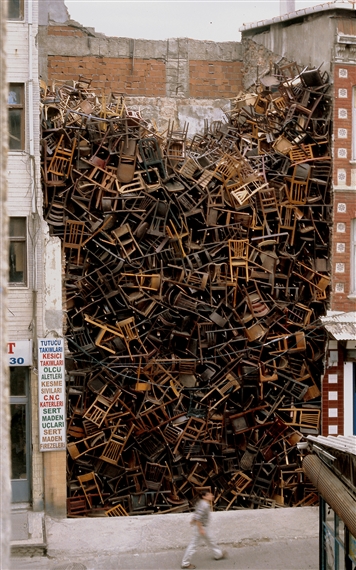
Quibans 15 - Chairs

From the Huffington Post, a brief Quibans involving a photograph.


This is a work of art by Doris Salcedo.  The installation is known as 'Istanbul'.

There is an obvious question ...


How many chairs are there?

Answer appears below.


1550

Source: http://www.huffingtonpost.com/mutualart/doris-salcedos-powerful-r_b_6871982.html

Tuesday, 26 January 2016

Quibans 14 - Refugees

From the Daily Telegraph, using data from European and British government sources:

What questions can we ask/answer about these graphics?


Possible questions:

  1. Were there 10 times as many asylum applications in Sweden as in the UK in 2014?
  2. Were there 3 times as many application in Germany as in the UK?
  3. What fraction of the asylum seekers in 2014 came from Syria?
  4. What fraction of those initially rejected were then accepted on appeal?

It makes sense for the students to look up the population of each of the countries mentioned and then calculate the number who applied for asylum in each country.

Possible answers:

  1. It depends on the population of each country.  This would only be true if the populations are equal.  In fact the population of Sweden is a lot smaller than that of the UK.  Sweden still had more asylum seekers than the UK, though.  (See the table below.)
  2. The population of the Germany is greater than that of the UK so there were more than three times as many in Germany.
  3. On the pie chart it looks like about a twelfth.  (It is very similar to the angle between two numbers on a clock.)  If you do the calculations you get 8%.  (NB this was for 2014 - the numbers for 2015 are likely to be higher.)
  4. About a quarter.  A common error here would be to divide the number who were successful on appeal by the number who were rejected, but the denominator should be the sum of those who were rejected eventually and those whose appeal was successful (because they were rejected first time around).  The calculation will necessarily be approximate because some of those who were successful on appeal in 2014 might have been on the unsuccessful list from 2013 or earlier.

Source: http://www.telegraph.co.uk/news/newstopics/eureferendum/12115770/The-EUs-back-is-against-the-wall.-It-wont-go-down-without-a-dirty-fight.html

Sunday, 17 January 2016

Quibans 13: Age trick

From the Daily Mail:
Maths magic! Sum that tells anyone's age and shoe size in just six simple steps

It’s the arithmetical trick that’s been causing delight and surprise but you’d better try it out on friends soon – because the later it gets into the year, the less likely it is to work.
Currently doing the rounds on social media, the poser involves a series of simple questions.
First ask your friend to think of their shoe size, then – using a calculator or a pen and paper – they should multiply it by five.
Next they add 50, and then take that total and multiply it by 20. They should add 1,015, and finally subtract the year of their birth. 
Magically, the result should be their shoe size and age, together making up a three or four-digit number. The trick works regardless of whether you use UK, European or American shoe measurements.
Questions:

  1. Does it work?
  2. Why does it work?
  3. Can you think of a way to break it?
  4. Is there a way to fix any problems?
Later in the article:

However, it won’t work for someone who has already had their birthday this year, or who is more than 100 years old.
You could add a step:  "If you have had your birthday this year add 1."
You can probably tell if someone is older than 100...
The other problem is if someone has a shoe size that finishes with a half.


Source: http://www.dailymail.co.uk/news/article-3403186/Maths-magic-Sum-tells-s-age-shoe-size-just-six-simple-steps.html

Quibans 12: Squash

From The Daily Telegraph:
Sport England’s rally to get people playing squash
England is the top nation when it comes to playing squash, but the number of participants is falling. Hopes are high that a new strategy will halt the decline.
Developed at Harrow School in the 1830s from the older sport of racquets, squash is played in 175 countries by an estimated 20 million people and has been called “the world’s healthiest sport” by Forbes magazine. England retains close links with the sport, possessing 8,500 squash courts – substantially more than any other nation.
However, participation in the sport in England has fallen to 196,500 weekly players from 290,000 in 2010, following a mini-boom between 2008 and 2013 that was aided by a drive from England Squash & Racketball to improve the participation of girls, women and ethnic minority players.


Questions:
  1. How can there be 196,500 weekly players but 325,000 monthly players?
  2. Is there a trend in the data?  Can you predict what it will be for 2015-16?
  3. What percentage of the monthly players have been lost between 2011 and 2015?
  4. How much of the time are the squash courts in use?
  5. Is 325,000 people a lot?

Source: http://www.telegraph.co.uk/sponsored/business/business-sport-series/12039758/playing-squash.html

Quibans 11: More Sugar

From The Guardian:

Sweet nightmares: a guide to cutting down on sugar
Many teenagers drink a can of soft drink a day. With around nine teaspoonfuls of sugar in a can, this alone pushes them over recommended guidelines with scant (if any) nutritional benefit. If price persuaded them to choose diet versions instead, it would make a real difference to their health. PHE has suggested taxing sugary soft drinks at 20%; others believe it should be higher. “The tax should be 50% if it is to reduce consumption,” says Tam Fry of the National Obesity Forum.

The graphic shows the number of tea-spoons of sugar in various foods:

Questions:
  1. What is the problem with using these figures? (If you would ordinarily have a muffin, if you replace it with biscuits, how many biscuits would you eat?)
  2. Which has the most sugar by volume? (You could calculate it per 100g, or per 1g.)
  3. Is it worth calculating how much sugar there is per hundred grams? Or per g? (It might not be - because you won't eat 100g of Salad Cream in one sitting but you might have 7 biscuits.)

Quibans 111: How much energy and water do our AI tools really use?

Here is how I used the article below from the Times.  Before showing the article, I started with this information and these questions: Mic...