Thursday, 2 June 2016

Quibans 32: Boring tunnels


From BBC News:
Swiss Gotthard rail tunnel - an engineering triumph

The world's longest - and deepest - rail tunnel opens in Switzerland on Wednesday [1 June 2016].

The Gotthard rail link has taken 20 years to build, and cost more than $12bn (£8.2bn). It will, the Swiss say, revolutionise Europe's freight transport.

The Alps are sometimes described as Europe's natural trade barriers. From Roman times, the routes across them have been mapped, and fought over.

But the plan was ambitious, costly to the Swiss taxpayers who had agreed to pay for it, and fraught with engineering challenges.

A massive 10m (30ft) diameter tunnel-boring machine could, on a good day, dig out 40m of tunnel a day - a world record.

But now the tunnel is ready, and Europe's leaders, including German Chancellor Angela Merkel, French President Francois Hollande and Italy's Prime Minister Matteo Renzi, are all arriving to take a look.

Twin tunnels running in both directions north-south should transport Europe's freight not only much more safely, but much faster. With no danger of collision, trains will race through the tunnel at speeds of up to 250km/h (155mph).

Where older alpine tunnels corkscrewed their way up through the mountains, the new railway line, from Zurich in the north all the way to Lugano in the south, is completely flat and straight.


What can we work out? (It might be useful to explain that there are two 10-metre diameter tunnels and that four boring machines were used – they met up in the middle.) This is one where the students could come up with their own questions. Here are mine:


  1. What exchange rate did they use?
  2. How much of the cost went on salaries? (What assumptions did you make?)
  3. How much did it cost per year?
  4. The Swiss people voted in a referendum to pay for the tunnel: look up how many people there are in Switzerland. How much did it cost them each, per year?
  5. How long is a football field?
  6. What volume of rock was cut on a good day?
  7. Give a lower bound for the length of time to drill the tunnel.
  8. How much freight does a single shipping container hold?
  9. How many times would the copper cable go along the tunnel?
  10. How much concrete is there in the Empire State Building?
  11. My favourite question: how thick is the concrete in the tunnel?


For question 11:
If we assume the tunnel was cut as a circle, diameter 10m and that there is an equal amount of concrete all around (presumably the base should be flat for the trains to run on, so this won't be perfect!) then we have this:


We could use trial and improvement to estimate the thickness of the concrete.
Or we could form and solve a quadratic equation.
Call the thickness of the concrete BC = t.
This gives AC = 5-t
The area of the red annulus is:

Multiply this by the length of the tunnel and this would equal (approximately) the volume of half of the concrete (because there are two tunnels).

Solving this (using the quadratic formula) gives about 1.3 metres.


Source:
http://www.bbc.co.uk/news/world-europe-36416506

Thursday, 26 May 2016

Quibans 31: Olympic preparations

from the BBC News website:

Rio 2016: Key facts ahead of the Olympics

From 5 August Rio will welcome 206 countries to four venues to compete for 4,924 medals across 42 sports... all in just 17 days of action.

A fleet of 21 jumbo jets would be required to fly all 10,500 athletes out to Rio.

Also in attendance will be 315 horses - more than enough horses to fill a Grand National field seven times over.

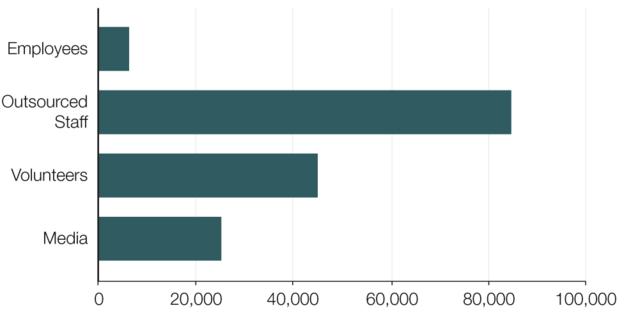
About 140,000 people are needed to host the Games in August. Of those, 90,000 will be employees with a further 50,000 volunteers.


Rio hotel room prices have jumped from an average of £67 to £196 a night, with only 14% of official hotel rooms left available.

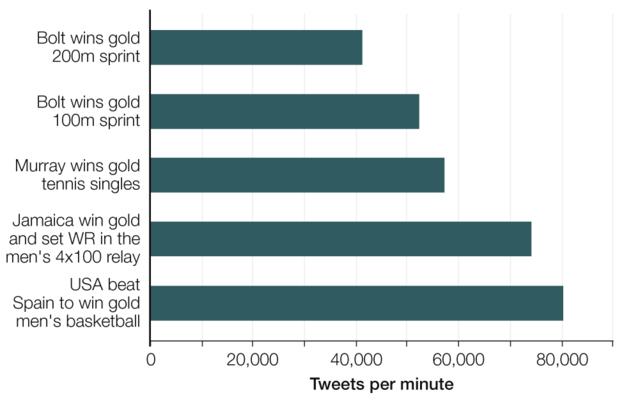
The most tweeted moments of London 2012:

There will be 32 tonnes of dead fish removed from the rowing and canoeing lagoon before the water-based activities take place.  That's the equivalent of 70,548lbs of Brazilian fish stew, enough to feed 47,032 locals their favourite Moqueca dish.

In total, about 7.5 million tickets for the Rio Games will be on sale. By the end of April, 60% had been sold.

Questions:
  1. How many seats are there on a jumbo jet?
  2. How many horses run in the Grand National?
  3. How does the number of media people compare to the number of volunteers?
  4. How many media people does each country send on average?
  5. Why is this not at likely to be the number sent by each country?
  6. What is the percentage price rise of a hotel room?
  7. Usain Bolt ran in the winning 4x100m relay team.  If you combine the tweets involving Bolt, how does this compare to the basketball final?
  8. Why might there have been more tweets about Andy Murray than about the USA basketball team?
  9. 1 ton = 2000 lbs.  1 tonne = 0.98 ton.  What percentage of the weight of fish stew is fish?
  10. How much fish stew does a Brazilian eat in one go?
  11. How many tickets were left at the start of May?
  12. I know that there are gold, silver, bronze medals for each event.  Why is it a surprise to read that there are 4,924 medals?
  13. What is wrong with the numbers about the fish stew?

Answers:
  1. The story claims there are 524 seats on a standard 747.  Using the figures in the article you might assume there are 500 seats.  At 524 seats per plane, on 20 planes you would get 10,480 - leaving just 20 athletes in the final plane!
  2. 315/7 = 45.  You could nearly stage 8 races, because there are actually 40 horses in the race.
  3. Just over half as many.
  4. It looks as if there are about 25,000 media representatives.  Divide this by 206 countries and you get 121.  (Better probably to do 25000/200 to give about 125.)
  5. Presumably small countries won't send as many people.  I assume that many of the events will be filmed by only the official Olympic broadcaster and the footage shared among everyone.
  6. £196/£67 = 2.93, which is 293% of the previous cost.  There has therefore been a 193% rise.
  7. 40,000 + 50,000 + 75,000 = 165,000 (figures are approximate), compared to 80,000.  This is just over twice as much.  
  8. The previous Olympics were in London, so people might have tweeted more about Murray's other matches.  It also says that the graph shows the number of tweets per minute.  We don't know which event prompted the most tweets overall.
  9. 32 tonnes = 31.36 tons = 62720 lbs.  62720 lbs / 70,548lbs = 0.889  This means each pound of stew requires 0.89 pounds of fish (but presumably some parts are thrown away (bones?). 
  10. 70,548lbs / 47,032 = 1.5
  11. 40% of 7.5 million is 3 million.
  12. 4,924 is not divisible by 3.  Some events (such as boxing) have 1 gold, 1 silver and 2 bronze medals.
  13. They are over-accurate.  The figure for the amount of fish is given as 32 tonnes - this will be an estimate and has clearly been rounded.  The number of people the fish stew would feed has been given to 5 significant figures!

Source:

Monday, 2 May 2016

Quibans 30: Footballers' salaries

This could be a brief task, or a longer one.  Beware - there are answers throughout the post.  Teachers might want to extract the images to display rather than projecting from the web.

The initial article comes from the Daily Telegraph:

Chelsea transfer news: 18-year-old Dominic Solanke demands £50,000 per week

Chelsea's inability to bring through a home-grown player since John Terry has left them in a difficult position over the future of teenage striker Dominic Solanke, whose list of demands is understood to include first-team guarantees and a contract worth over £50,000-a-week.

Solanke is one of the most highly-rated young forwards in the country, but the 18-year-old’s Chelsea contract is due to expire in 12 months and talks over a new deal have hit an impasse.

Solanke has made one senior appearance for Chelsea, in the Champions League. The club value him as a highly promising player with the potential to break through, which was reflected in a first professional contract worth £7,000-a-week that was signed in September 2014.

To put Solanke’s alleged demands into perspective, Harry Kane currently earns around £50,000-a-week at Tottenham Hotspur and was collecting £20,000-a-week as recently as January 2015.


Questions:
  1. What is Solanke’s annual salary at the moment?
  2. What does he want it to be?
  3. What percentage pay rise would that be?
  4. What percentage pay rise did Kane receive? 
Answers:

  1. £7,000 x 52 = £364,000
  2. £50,000 x 52 = £ 2.6 million
  3. Rise is (50 – 7) thousand = 43,000. 43/7 x 100% = 614% 
  4. 30/20 is a pay rise of 150%
This can be extended further by using the brilliant website http://www.whatfootballersearn.com

Here is a comparison between arguably the two best players in the world:

What questions could we ask/answer here? Here are some examples:

  • What is their salary per year?
  • How much tax do they pay? (Will need to look up Spanish tax rates)
  • What is the percentage by which Messi out-earns Ronaldo?
  • How much do they each earn per second?
And here are the answers given by the website:

Messi out-earns Ronaldo by (336 – 274) / 274 = 23%

Martin Odegaard was signed by Real Madrid as a 16-year-old. Here is his salary compared with Wayne Rooney’s:

To save us lots of calculator work, it would make sense to create a spreadsheet (optional). It might look something like this, so we could type the weekly salary into a yellow cell:
Now we need to consider rounding issues.

Can we extend it so we can work out how long it will take each of them to afford particular things (such as an iPhone, or a new car)?

Also on the website is a comparison page. The UK average salary is £26,500 per year, so I have typed that in:

I left the website up for about 2 minutes before I took the image. Can you work out the values?

Here is the answer:

Can you work out exactly how long the page was up before I took the image?

(Answer: 124.6 seconds)

I let the page run for a while. When it said this how much had someone on the average wage earned?


Answer:


Final thought: the values given here are the footballers’ basic salaries, as paid by their clubs. They get extra for endorsing and advertising other products too. It is an irony that if I want a pair of top-of-the-range football boots then I need to pay several hundred pounds for them, whereas Rooney et al are not only given boots but are paid to wear them!

Sources:
http://www.telegraph.co.uk/football/2016/04/25/chelseas-dominic-solanke-demands-50000-per-week/
http://www.whatfootballersearn.com/compare/cristiano-ronaldo/vs/lionel-messi/
http://www.whatfootballersearn.com/matcher/?salary=26500&match=false&player_id=852

Saturday, 30 April 2016

Quibans 29: Slugs

This is an edited excerpt from an article in the Daily Mail (with thanks to @jamesbakermaths for the suggestion).

Prepare for a slime wave! _____ slugs are expected to invade our gardens over the coming weeks as mild weather continues

The mild weather has created perfect conditions for the slimy pests, which have not been encouraged to hibernate because the weather hasn’t been cold enough.  As a result, the so-called 'sleepless' slugs have been eating and breeding non-stop - causing their numbers to explode.

According to the charity BugLife, the average British garden contains around 20,000 slugs, with each one laying between 20 and 100 eggs.  Combined with last year's wet summer, BugLife reckons the general slug population could be up 10 per cent this year.

‘The impact of super-sized, sleepless slugs could spell devastation for our gardens this summer.’
Slugs will not go into hibernation unless the temperature drops below 5°C - but the average temperature during the winter was a balmy 6.7°C.


Questions:
  1. Estimate how many slugs there are in British gardens in total.
  2. Is it reasonable to think there are 20,000 slugs in a garden?
  3. How many slug eggs are there in total?
  4. What was the ‘general slug population’ last year?
  5. What is wrong with the final sentence of the article?

Answers:
  1. From the article (before it was edited):  According to the charity BugLife, the average British garden contains around 20,000 slugs, with each one laying between 20 and 100 eggs. And with 21 million gardens in the UK, that means up to 420 billion slugs could be waiting to set upon the nation's plants.
  2. If we assume a garden is the size of the classroom, that might give 6 metres by 6 metres. 600cm by 600cm is 360,000 sq cm, so there would be one slug per 18 sq cm. If the average garden is a square of side 10m then that becomes one slug per 50 sq cm. Seems like a lot!
  3. Should we assume that on average each slug lays 60 eggs? (Do male slugs lay eggs too, or just female ones?) 420 billion x 60 = 25 trillion eggs.
  4. To undo a 10% increase we divide by 1.1 - this is about 380 billion slugs.
  5. Slugs hibernate when the temperature dips below 5°C. An average temp of 6.7°C doesn’t mean the temp was above 5 degrees the whole time. Presumably it was below 5 at some point, so the slugs will have slept then.

Source:
http://www.dailymail.co.uk/sciencetech/article-3565939/Prepare-slime-wave-420-billion-slugs-expected-invade-gardens-mild-weather-continues.html


Thursday, 7 April 2016

Quibans 28: Food activity icons

From BBC News:

Activity icons 'could help healthy living’

We think a clearer way of making people more mindful of the calories they are consuming is for a food or drink product to also show on the front of the packet a small icon which would visually display just how much activity you would need to do to burn off the calories it contains.
A selection of food and drink products and the exercise needed to burn off their calories
Take, for example, a medium coffee mocha. Who'd have thought that this could contain nearly 300 calories?
We recognise that just to live and breathe we need to consume a certain number of calories every day - for a man that's about 2,500 and for a woman 2,000.
But anything more than this, without a more active lifestyle, could lead us to gain weight.


Possible questions:
  1. What is the link between running and walking?
  2. How much exercise do you need to do to burn off the mocha?
  3. What is the formula to help work out how long you will need to run to burn off a certain number of calories?
  4. If you run for an hour how many calories does this predict you will burn?
  5. If you ran for a full 24 hours, how many calories would you use?

Source:
http://www.bbc.co.uk/news/health-35981098

Tuesday, 5 April 2016

Quibans 27: Cheap jeans

This is an unusual Quibans in that is lengthier than normal. In other Quibans the text has been edited to remove some of the irrelevancies and so it can be projected easily. This time I have included the full article text.  
You may want to send students to the original article:
They could read this and could try to make sense of the numbers involved.

This feels like a homework activity to me. Things to do:
1)  Itemise the cost of a pair of jeans (eg, how much is labour, how much shipping, how much for materials, etc).
2)  What percentage of the price we pay for jeans goes to each part of the supply chain?
3)  If the jeans were 50p more expensive, with all of that extra money going to those who make the jeans, what effect would that have on the salary of those workers?
4)  Why can't all of that extra money go to the workers?  (VAT!)

Here is the article from the Guardian newspaper:

How can Lidl sell jeans for £5.99? Easy … pay people 23p an hour to make them


Abracadabra! “Jean genie Lidl magics up £5.99 denims,” shouted the headline in a newspaper last weekend as it extolled the brilliance of the cut-price supermarket chain in once again undercutting its rivals.

The German retailer, it explained, was continuing its assault on the traditional supermarket giants by targeting the high street fashion-conscious with jeans selling for an astonishing £12 less than a similar pair in Tesco.

How could these retail wizards do it? The unchallenged line from Lidl was that its huge buying power was the answer. It was just good at doing deals.

But let us be clear. This is not magic. It is not Harry Potter making these jeans, it is a young woman in a factory in Bangladesh and one of the main reasons they are so cheap is that workers like her are paid as little as 2p for every pair they make.

Still, £5.99 is quite an achievement when even Primark – no slouches in the cost-cutting field – have only managed to get their lowest price down to £8. So how do they do it?

“Lidl surprises” is the slogan the supermarket currently uses to punningly flog its wares, but it is no surprise to discover that the firm, like many of the British high street retailers, does much of its clothes shopping in Bangladesh, where the minimum legal wage for a garment worker is 23p an hour.

Sure enough, when the new range launched on Thursday morning at Lidl’s more than 600 UK stores as part of the “We Love Denim” promotion – the word “love” denoted by a denim heart – the labels revealed Bangladesh as the source of the jeans. In a range of sizes and colours, they are dumped higgledy-piggledy in wire baskets at the rear of the store, but even Lidl’s most ardent fans would probably concede that no one seeks out the stores for a retail therapy experience, so there are a few pennies saved on display costs for starters.

The headline-grabbing £5.99 offering is actually a pair of “jeggings” – tight-fitting leggings that resemble jeans. The label says they have a “stylish denim effect”. Cotton-rich fabric (77%), with an elasticated waistband; they have a single button, a YKK zip, two back pockets and two at the front, held together with stitching, no rivets. There is no embroidery on the pockets.

This is all important. Every additional detail adds to the price of the finished item. A breakdown of costs at a Bangladeshi jeans factory published by Bloomberg in 2013 priced a zip at 10p, a button at 4p and rivets at 1p each. Embroidery added another 9p, the pockets 6p and the labels 7p. At these margins, every single penny counts, so it is no surprise to find that the jeggings are pared back to the bone.

But the Boyfriend Jeans, at £7.99, appear to be the real thing: four pockets plus that baffling little one inside the front pocket on the right of the body (it is a watch pocket, apparently). There are six belt loops, five rivets, three buttons and a YKK zip. And they are made from 100% cotton, the material being the most expensive element of the production process: in the range of £2.30 to £2.50.

There is thread to pay for too, for the stitching, which might be as much as 19p, and the finished pair will need to be washed, so if we are going to try to put a price on the materials we are probably looking around the £3.90 mark.

Now we need to assemble those materials. Luckily – for the buyer – that is not nearly as expensive.

Most of the workers in Bangladeshi garment factories are women and most are paid at the minimum legal wage of 5,300 takas a month (about £48). That is 23p an hour on an eight-hour, six-day, week. It is a fifth of the £230 a month estimated by the Asia Floor Wage Alliance to be the minimum required for a living wage back in 2013.

To accurately work out the labour cost, you need to know how many pairs of jeans the factory turns out a day. The available figures cover quite a broad range: research in India found workers in one factory averaging 20 pairs a day, while a different study in Tunisia found 33 pairs a day. It all depends on the quality and complexity of the design. In 2010 the Institute for Global Labour and Human Rights looked at Bangladesh and found a team of 25 workers turning out 250 pairs of jeans an hour – 10 per worker, or 80 per worker per day.

That means a minimum wage worker would be paid somewhere in a range between 2p and 9p for each pair of jeans they make, which is broadly in line with a 2011 study of Bangladeshi garment manufacture by the US consultancy O’Rourke Group Partners, which priced the labour costs for a polo shirt at 8p.

O’Rourke put the total factory costs per shirt at 41p: Bloomberg calculated its Bangladeshi jeans cost the factory 56p to make, and the factory added on 16p in profit.

Splitting the difference, we are now up to about £4.50. But we still need to ship the jeans, and there are warehouse charges and port fees, so we can stick on another 30p, taking us up to £4.80. And we still need to get them from the port to the store, so that’s another 50p. That gives us £5.30, but there is still VAT to go on top.

The grand total of £6.36 would bust the budget for the jeggings, but they use a little less material, and we have saved a few pennies on the buttons and rivets. That will make them quicker to turn out, so that is a bit off the labour costs. It might just about be possible to bring them in at £5.99 or they may be a loss leader: that happens. The jeans, meanwhile, are showing a profit of £1.63.

But this is where Lidl’s purchasing power has to kick in, because both the jeggings and the jeans are imported by middlemen, who sell on to the supermarket – respectively OWIM Gmbh, a German company, and Hong Kong-based Top Grade International Enterprise Ltd, which exports 30 million pieces a year from Bangladesh. Both need to take their cut. In the Bloomberg example, the middleman took a cut of £2. That is clearly out of the question here if Lidl is to turn a profit itself. And that is the reality of a £5.99 pair of jeans: everyone is squeezed, all down the line.

Times are tough. Customers demand the cheapest possible clothes. Lidl’s success is built on this: that is how it racked up £4bn of sales in 2014. It meets a need and it does so by putting the tightest possible squeeze on its suppliers. Lidl argues that it is aware of its responsibilities and is working to improve the living and working conditions of garment workers. It audits its factories, it says, but everyone does. It does not publish the results. Hardly anyone does.

Unusually, Lidl has experimented with a system of top-up bonuses for some workers, which is more than can be said for most of its rivals. But then, it really does need to.

Because when your business model is based on offering the lowest possible prices, someone has to subsidise that, and that someone is the worker stitching those jeans. Lidl does not buy its jeans from Bangladesh because Dhaka’s factories are the finest in the world: it does so because they pay their workers a pittance. And that, ultimately, is how it is possible to sell a pair of jeans for £5.99.

It’s not magic. It’s just exploitation.

Quibans 26: Fewer Shoppers

From the Cambridge News:

Cambridge is losing shoppers as footfall drops - but high parking charges 'not to blame'


High street footfall in Cambridge city centre has dropped almost twice the national average over the past year, the News can reveal.

Some 153,323 fewer people took to the streets of Cambridge in the first 12 weeks of 2016, with footfall decreasing to 3,846,559 from the equivalent 3,999,882 last year.

The figures, collected by Cambridge BID through footfall cameras, mark a reduction of ### per cent – significantly higher than the UK-wide decline of 2.12 per cent.

But Ian Sandison, chairman of Cambridge BID, said the decline was "small" and needed to be looked at in a wider context of changing shopping habits driven by technology and click and collect.

The data, from Bridge Street and Sidney Street, was calculated until the end of week 12 – which this year (2016) included Easter Sunday – but does not include Easter 2015 as it fell slightly later.

Kevin Blencowe, executive councillor for planning policy and transport at Cambridge City Council, said he did not believe the cost of city centre parking lay behind the decline.

"It's hard to tell what the factors are," he said. "Clearly online shopping has an impact but I would have thought that would even out over the year.

"Traditionally the early weeks of the new year are quiet in retail terms with people having spent a lot of money in the Christmas season so there's always a lull."

Possible questions:
  1. What is the percentage reduction?
  2. Is it reasonable to describe this as a drop of "almost twice the national average"?
  3. How many people are there per week?
  4. 12 weeks is 12x7 = 84 days.  Why can't we divide the total number of people by 84 to get the number of people per day?
  5. What effect might Easter have?
  6. Why are the two quotes from the councillor irrelevant?
Answers:
  1. 153323/3999882 = 3.83%
  2. It is 1.8 times the national average, which is "almost twice", so this is reasonable
  3. 3846559/12 = 320546.6 - this needs to be rounded sensibly (to 32,000 ?).  This is an average.
  4. This would only work if there were same number of people per day.  Presumably there are more on a Saturday and on weekend evenings.
  5. Maybe fewer people go shopping on Easter weekend?  Maybe people go and shop on the two bank holidays?  (Could be fewer people, could be more people!)
  6. The article compares the first 12 weeks of 2015 with the first 12 weeks of 2016, so any post-Christmas lull would be similar in both years.

Source:

Quibans 111: How much energy and water do our AI tools really use?

Here is how I used the article below from the Times.  Before showing the article, I started with this information and these questions: Mic...